This page contains the presentation materials for Dr. Shaheen’s 8/6/26 presentation at the Civics of Technology Conference.
1. Expanding Presentation Norms
- Why are slides the norm?
- Cute consequences
- Prioritizing nonvisual access for blind and low-vision people
Sidebar: Fully accessible slide decks are attainable and blind people can create slide decks.
2. Overview
- Inaccessible instructional technologies
- Inequities for blind and low-vision (BLV) students
- Evades teachers’ notice
2.1 A11y in Sci
- NSF funded
- Case library: harmful impacts of inaccessible technology
- 2 Case-based learning (CBL) units
- Teachers of blind students: undergraduate & graduate access technology course
- General education teachers: undergraduate secondary special education course
3. ADA Title II Regs
- Read the Rule or the Fact Sheet
- Compliance:
- Originally April 24, 2026
- Rolled-back to April 24, 2027
- State & local government: K-12 schools
- Websites
- Mobile apps
3.1 WCAG
- Web Content Accessibility Guidelines 2.1 AA
- Technical standard:
- POUR: Perceivable, Operable, Understandable, & Robust
- Headings: <h1> , <h2>, ….
- Section titles on this page are headings
- Alternative text
- Descriptive/meaningful links:
CLICK HERE- All links on this page are meaningful
4. Cultivating A11y-ship
- A11y-ship: A commitment to creating born accessible classes
- Proactive not reactive
- Disabled students can show up any time and learn alongside their peers
- Accessible technology & pedagogy
- Examining power structures, particularly ableism
- Opportune time to cultivate a11y-ship among preservice teachers
5. Status Quo
- Inaccessible instructional technologies are a systemic problem in K-12 (Shaheen & Lohnes Watulak, 2019)
- Teachers (and administrators) are unaware that
- Technologies can be inaccessible
- How inaccessible technologies harm BLV students
- How to tell whether a technology is accessible
6. Accessibility4Equity
- Theoretical framework
- Sociotechnical praxis to disrupt systemic ableism & construct born accessible technology-mediated classes (Shaheen, 2022)
- Pedagogy: Universal Design for Learning
- Technology: WCAG
- Reflection: how ableism shapes decisions about which learning supports are inherent (e.g., slides) versus auxiliary
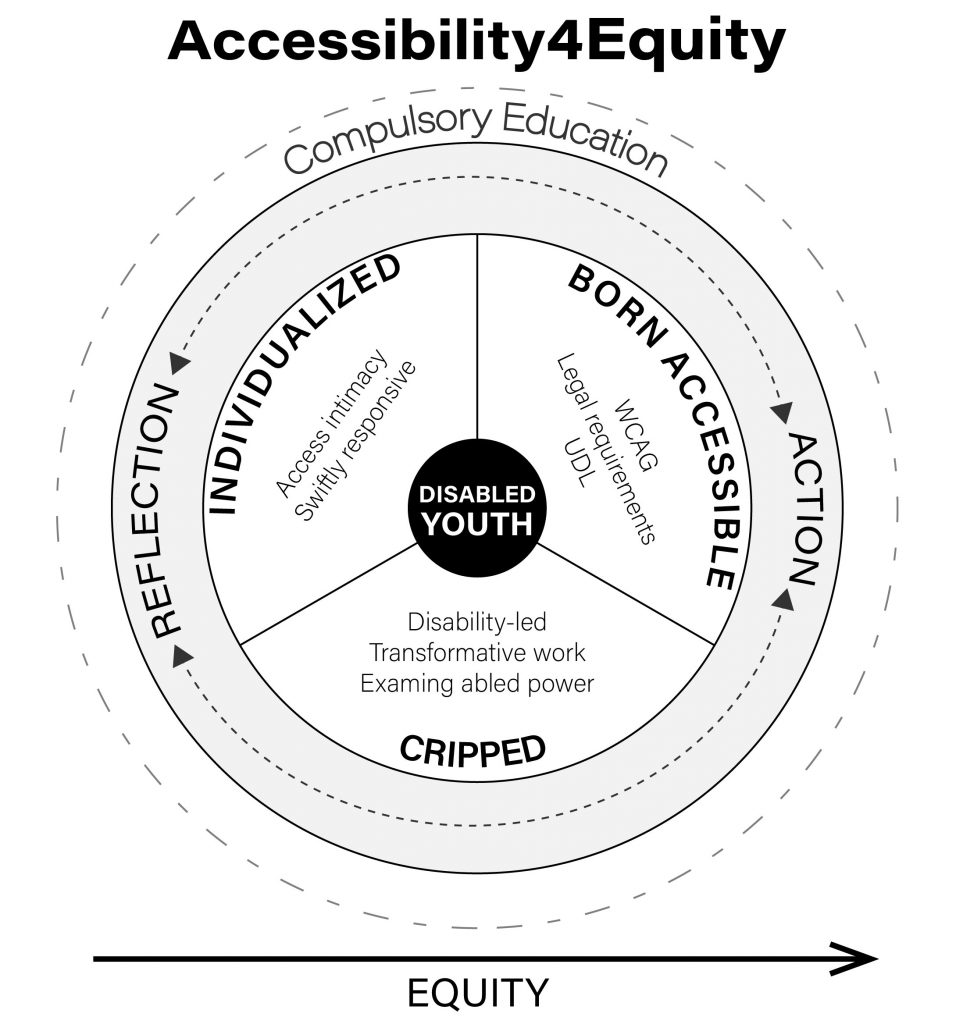
Alternative Text: The Accessibility4Equity figure features four nested concentric circles, creating a small center circle surrounded by three rings. The center circle is labeled Disabled Youth. Moving out from the center circle, the inner ring is divided into three congruent segments. The first segment, Born Accessible, reads: WCAG, legal requirements, and UDL. The second segment, Individualized, reads Access intimacy and Swiftly responsive. The third segment, Cripped, reads Disability-led, Transformative work, Examining abled power. The medial ring features the labels Reflection and Action positioned across the ring from one another with two-way arrows connecting them. The dashed outer ring is labeled Compulsory Education. Below the nested circles an arrow labeled Equity points to the right.
Sidebar: Real alternative text is not displayed on screen. It is embedded in the HTMl and read by screen readers
7. A11y in Sci Case Library
- Case library
- Research-based short stories
- BLV students & their teachers learning & working in in/accessible tech-mediated classes
- 18 stories (so far)
- Prioritized accessibility in dev process
- Interface: filtering, glossary, character bios
- Case metadata: instructional tech, access tech, WCAG
7.1 Stories
- Simulation Frustration relays Captain Marvel’s experience with inaccessible biology simulations and her teachers’ failed attempts to make the technology-mediated unit accessible.
- Sometimes I Cry describes the shame and despair Rebecca felt when selecting high school classes based solely on how accessible she thought they would be.
- In Kahoot Kapoot three blind teens put Kahoot on blast and strategize about how to get their teachers to ditch the “game.”
8. CBL Unit for Teachers of Blind Students
- Undergraduate & graduate access technology course
- 1st unit
- 5 weeks
- Extensive reading from case library: primarily student-selected cases
- Reflection
- Guided inquiry into the complexities of teaching and learning
8.1 Wk 1 Asynchronous Lab
You are a teacher of blind students in a suburban district in New England. You have some high achieving students on your case load this year, including Captain Marvel. She uses screen readers to access all her classes, except English and Latin where she uses Braille. You’ve been working hard over the first two weeks of school to get the gen ed teachers up-to-speed. But there are so many of them and only one of you.
Yesterday, after school, you got a text from Captain Marvel; her biology teacher, Ms. Walsh, used an inaccessible photosynthesis simulation in class. According to Kylie Walsh, simulations are a large part of the bio curriculum. You’ve heard that the simulations Kylie is using are an accessibility dumpster fire.
What would you tell Ms. Walsh?
- Assign Captain Marvel appropriate readings from the textbook instead
- Let Captain Marvel read her independent reading book
- You’ll have Mrs. Brown, the para, help Captain Marvel do the simulations
8.2 Wk 2 Small Group Activity
| Approach to addressing inaccessible bio sim | Captain Marvel (Student) | Ms. Walsh (Sci Teacher) | Mrs. Collins (teacher of blind students) |
|---|---|---|---|
| Read Independent reading book or do homework | Main Challenges: Feelings: | Main Challenges: Feelings: | Main Challenges: Feelings: |
| Have para (Mrs. Brown) help with simulation | Main Challenges: Feelings: | Main Challenges: Feelings: | Main Challenges: Feelings: |
| Read textbook | Main Challenges: Feelings: | Main Challenges: Feelings: | Main Challenges: Feelings: |
8.3 Wk 3 Small Group Activity
- After learning about WCAG
- Identify the WCAG principles (POUR) and guidelines related to the cases you’ve read so far
- Check your ideas against the case metadata
8.4 Culminating Project
- Your accessibility story: 2 options
- The story of learning about accessibility as a preservice teacher
- The story of how your future self (a fifth-year teacher) incorporates accessibility into their teaching practice
- Any format: prose, poetry, spoken word, imagery, etc.
- Story must be accessible
- Student Poem: Dear Me, When You Get There
9. CBL Unit for Gen Ed Teachers
Collaboration with Dr. Kim Fisher
- 1 required special ed course for secondary general ed teachers
- Broad survey course addressing all subjects & all disabilities
- 3 week end of term unit
9.1 Wk 1 Connection to Ableism
- Ableism is a fundamental construct throughout the course
- Cases: Sometimes I Cry OR Speed Reader
- Reflection questions help students connect accessibility and ableism
- What role does ableism play in teachers making or not making digital content accessible?
- Thinking of your classroom experiences, what types of ableism have you seen in digital resources?
- Compare how the teacher(s) supported or interacted with the blind student and the blind student’s experience of that support? What role do beliefs about disabled people have in these experiences?
9.2 Wk 2 Applying POUR
- Student selected cases
- Small group activity & gallery walk
- What WCAG or POUR Principle is being violated or addressed?
- What is the impact on students?
9.3 Wk 3 Systems Jigsaw
| Content Area | Case Story |
|---|---|
| Sciences Education, Engineering Education, Family Consumer Sciences Education (labs) | Beyond Grades: Accessibility Fail in Engineering Education |
| Visual and Musical Arts Education | Getting My Grades |
| Social Sciences Education | Kahoot Kapoot or Whiteboard Woes |
| English Education, Drama Education | Working Killer Hours |
| Physical Education, Health Education | Simulation Frustration |
Round 1: Content area groups read assigned case and reflect
- What do the teachers do when they find out things are inaccessible?
- What else could be happening that contributes to this incident?
- What role does the school or district have in this situation?
- Many of these stories do not have a direct link to your content area. How does what you learned apply to your content area?
Round 2: Cross discipline groups discuss patterns and change
- How can educators use Gorski’s Equity Literacy Framework to address inaccessibility and make more lasting change?
- How can the system be addressed to better support the educator?
10. Other Ideas for Using the Cases
- Hook or foundation for accessibility units
- Instructional technology courses: select cases that address the tech you are discussing
| Technology | Case |
|---|---|
| Gamification | Kahoot Kapoot |
| Simulations | Sometimes I Cry & Simulation Frustration |
| Slide Decks | A Tale of Two Teachers: My Journey in Calculus |
| CAD | Beyond Grades: Accessibility Fail in Engineering Education |
| Student Information Systems | Getting my Grades |
| Computer-aided tests | Testing the System |
11. Forthcoming Work
- Interface refinement
- More cases: Teacher POV
- Refining both CBL units
- CBL units as OERs
12. References
Shaheen, N. L., & Lohnes Watulak, S. (2019). Bringing disability into the discussion: Examining technology accessibility as an equity concern in the field of instructional technology. Journal of Research on Technology in Education.51(1), 187–201. https://doi.org/10.1080/15391523.2019.1566037
Shaheen, N. L. (2022). Accessibility4Equity: Cripping technology-mediated compulsory education through sociotechnical praxis. British Journal ofEducational Technology. 53(1), 77-92. https://doi.org/10.1111/bjet.13153